Most pediatric dentists agree that regular dental care should begin when a child gets their first tooth or no later than the child's first birthday. Most children should have a dental checkup at least twice each year after that. Some children may need checkups and care more often. Experts advise the following:
Birth to age 6 months
-
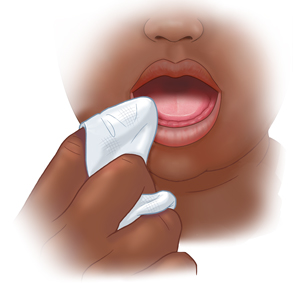
Clean the baby's mouth with gauze or use a soft infant toothbrush after feedings and at bedtime.
-
Talk with your child's dentist or doctor about fluoride supplements if you live in an area without fluoridated water.
-
Regulate feeding habits (bottle-feeding and breastfeeding).
Ages 6 to 12 months
-
During this time, the first tooth should appear. Talk with a pediatric dentist for an exam.
-
Ask about fluoride varnish that may be applied to the teeth every 3 to 6 months.
-
Brush teeth after each feeding and at bedtime with a small, soft-bristled brush and a small amount of fluoride toothpaste, about the size of a grain of rice.
-
As the child begins to walk, stay alert for possible injuries to the teeth or face.
Ages 12 to 24 months
-
Follow the schedule of dental exams and cleanings, as recommended by your child's pediatric dentist. Generally, dental exams and cleanings are advised every 6 months for children and adults.
-
As your child learns to rinse and spit, brushing with a small amount (about the size of a grain of rice) of a fluoride toothpaste is okay, in most cases.
Facts about baby teeth
-
Correct care of a child's baby teeth (primary teeth) is very important. Baby teeth hold space for the future eruption of permanent teeth.
-
If a baby tooth decays or is removed too early, the space needed for the permanent teeth is lost. It can only be regained through orthodontic treatment.
-
Infected baby teeth can cause the permanent teeth to develop incorrectly. This can cause stains, pits, and weaker teeth.
-
Baby teeth are important for speech development.
-
Baby teeth aid in chewing food correctly, which helps with healthy nutrition.
-
Most children begin losing their baby teeth around the age of 5 or 6, often with the front teeth first. They continue to lose baby teeth until the age of 12 or 13. This is when all the permanent teeth finally come through, except for the third molars (wisdom teeth). These molars begin to appear around ages 17 to 21.
Diet and dental care for children
The American Academy of Pediatric Dentistry advises the following to make sure that your child eats correctly to maintain a healthy body and teeth:
-
Ask your child's pediatric dentist to help you assess your child's diet.
-
Shop smart. Don't stock your pantry with sugary or starchy snacks.
-
Buy "fun foods" only for special times.
-
Limit the number of sugary snacks and choose nutritious snacks.
-
Provide a balanced diet and save foods with sugar or starch for mealtimes.
-
Don't put your young child to bed with a bottle of milk, formula, or juice.
Featured in
Online Medical Reviewer: Jessica Gotwals RN BSN MPH
Online Medical Reviewer: Michael Kapner MD
Online Medical Reviewer: Rita Sather RN
Date Last Reviewed: 09/01/2025
© 2000-2026 The StayWell Company, LLC. All rights reserved. This information is not intended as a substitute for professional medical care. Always follow your healthcare professional's instructions.