Types

Understanding Heart Valves

Choose a preferred language

The heart has four valves. They are the aortic, pulmonary, tricuspid, and mitral valves. The valves open and close to keep blood moving in the right direction through the heart. Blood moves through the heart as it beats. With each squeeze, the valves open and close to keep blood moving forward. In this way, valves keep blood moving as well as possible through the heart. They also prevent backflow.
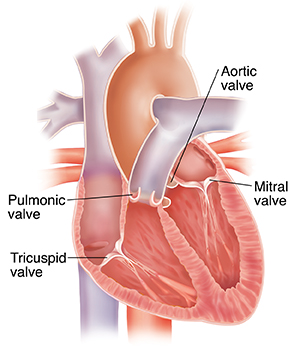
Cross section of heart showing four valves.

When the heart relaxes between beats:

  • Oxygen-rich blood from the lungs fills the left atrium.

  • Oxygen-poor blood from the body fills the right atrium.

When the atria beat:

  • The left atrium squeezes. This pushes blood through the mitral valve into the left ventricle.

  • The right atrium squeezes. This pushes blood through the tricuspid valve into the right ventricle.

When the ventricles beat:

  • The left ventricle squeezes. This pushes blood through the aortic valve out to the heart arteries, the brain, and body.

  • The right ventricle squeezes. This pushes blood through the pulmonary valve to the lungs.
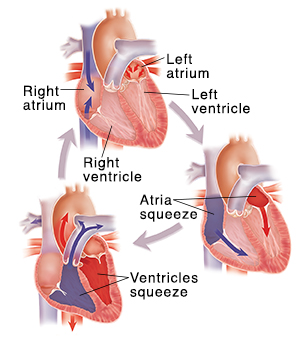
Diagram of three cross-sectioned hearts showing blood flow during heartbeats.

Online Medical Reviewer: Glenn Gandelman MD MPH

Online Medical Reviewer: Lu Cunningham RN BSN

Date Last Reviewed: 08/01/2023

© 2000-2026 The StayWell Company, LLC. All rights reserved. This information is not intended as a substitute for professional medical care. Always follow your healthcare professional's instructions.



Find a Provider

View Our Directory

Find a Location

View Our Practices
Related Articles
Read article
Heart Health
Arrhythmogenic Right Ventricular Cardiomyopathy

Arrhythmogenic right ventricular cardiomyopathy (ARVC) is a disease of the heart muscle. In this disease, fatty fibrous tissue replaces normal heart muscle. This interrupts normal electrical signals in the heart and may cause irregular and potentially life-threatening heart rhythms. The heart also becomes weaker over time leading to heart failure.

Read article
Heart Health
Heart Failure: After Your Hospital Stay

Here's how you can stay healthy and prevent the problems that lead to a stay in the hospital.

Read article
Heart Health
Understanding Postural Orthostatic Tachycardia Syndrome (POTS)

Postural orthostatic tachycardia syndrome (POTS) is a condition that causes your heart to pump too fast for too long after you stand up.

Read article
Heart Health
Atherosclerosis

Atherosclerosis is a type of thickening or hardening of the arteries caused by a buildup of plaque in the inner lining of an artery. It can increase your risk of heart attack, stroke, and other circulatory conditions.