Treatment

Fetal Positions: Special Care During Childbirth

Choose a preferred language

A baby (the fetus) often moves down between the pelvic bones (descend) before birth. If this is your first pregnancy, this may happen 2 to 4 weeks before labor. With repeat pregnancies, the baby may not “drop” until labor begins. The baby usually moves down headfirst. If your baby is not in a safe position for birth, or if there is a problem with the placenta, you may need special care. A cesarean section delivery may be needed.
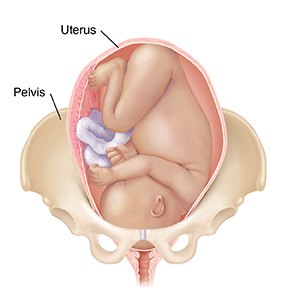
Front view of full-term fetus in uterus between pelvic bones with head down.


Conditions that require special care

Cephalopelvic disproportion (CPD). Baby’s head or body is too big for the pelvis.
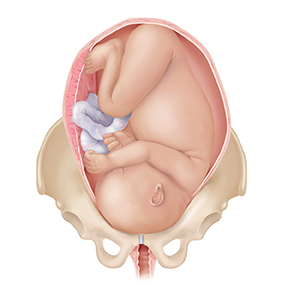
Front view of full-term fetus in uterus between pelvic bones, with head down. Head and body are too large for birth canal.

Breech position. Baby is positioned with feet or buttocks first.
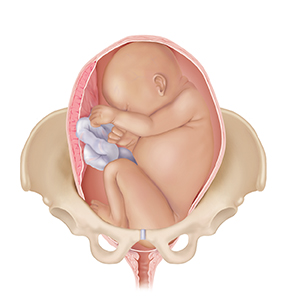
Front view of full-term fetus in uterus between pelvic bones with head up, showing breech position.

Transverse position. Baby lies horizontally across the pelvis.
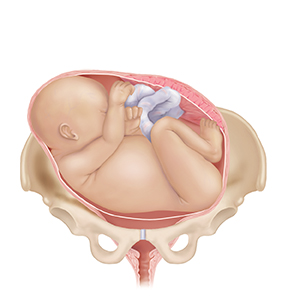
Front view of full-term fetus in uterus between pelvic bones with fetus' body lying sideways over birth canal, showing transverse position.

Placental abruption. Placenta separates from the uterus.
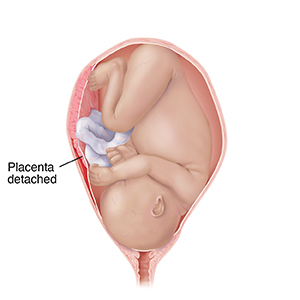
Front view of full-term fetus in uterus in pelvic bones with head down. Placenta is detached from wall of uterus showing placental abruption.

Placenta previa. Placenta blocks the cervix.
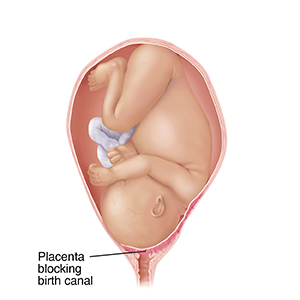
Front view of full-term fetus in uterus between pelvic bones with head down. Placenta is blocking birth canal, showing placental previa.

Online Medical Reviewer: Daphne Pierce-Smith RN MSN

Online Medical Reviewer: Tennille Dozier RN BSN RDMS

Online Medical Reviewer: Vinita Wadhawan Researcher

Date Last Reviewed: 06/01/2025

© 2000-2026 The StayWell Company, LLC. All rights reserved. This information is not intended as a substitute for professional medical care. Always follow your healthcare professional's instructions.



Find a Provider

View Our Directory

Find a Location

View Our Practices
Related Articles
Read article
OB/GYN
Cesarean Section (C-Section)

When your baby is delivered by C-section, it means the surgeon makes a cut in your belly to reach the infant and remove them from the womb. In many cases, a C-section is unexpected. It is done to make sure that you and your baby have the safest birth.

Read article
OB/GYN
Methotrexate to Treat an Ectopic Pregnancy

Learn how to care for yourself after being given methotrexate for an ectopic pregnancy.

Read article
OB/GYN
Childbirth: What Is Epidural Anesthesia?

Epidural is a kind of medicine to block pain (anesthetic). It is commonly used during labor and delivery. During an epidural, anesthetic is injected into the area around your lower spine. An anesthesiologist or nurse anesthetist starts the epidural and watches you during your procedure.

Read article
OB/GYN
Labor Induction

Labor induction is a way to help get your labor started. This can protect your health and your baby's, too.