Prevention

Bent-Knee Calf Stretch

Choose a preferred language

This exercise is designed to stretch the muscle in your calf called the soleus. Before starting the exercise, read through all the instructions. While exercising, breathe normally and don't bounce. If you feel any pain, stop the exercise. If pain persists, inform your doctor:

  • Stand an arm's length away from a wall. Place the palms of your hands on the wall. Step forward about 12 inches with one foot.
  • Keeping toes pointed forward and both heels on the floor, bend both knees and shift your hips forward until you feel a stretch in the calf of your back leg. Hold for 30 to 60 seconds. Relax.
  • Repeat 2 to 3 times, or as instructed.
  • Switch sides and repeat 2 to 3 times, or as instructed.
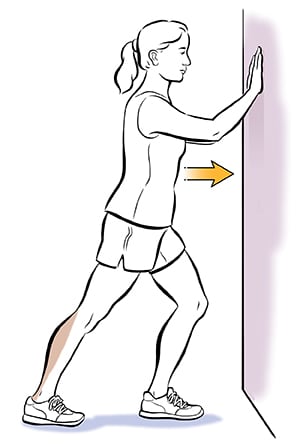
Person leaning hands on wall doing calf stretch.

Online Medical Reviewer: Elizabeth Oswald PT DPT

Online Medical Reviewer: Marianne Fraser MSN RN

Online Medical Reviewer: Trina Bellendir PT

Date Last Reviewed: 02/01/2024

© 2000-2026 The StayWell Company, LLC. All rights reserved. This information is not intended as a substitute for professional medical care. Always follow your healthcare professional's instructions.



Find a Provider

View Our Directory

Find a Location

View Our Practices
Related Articles
Read article
Heart Health
Discharge Instructions: Administering IV Antibiotics

Your healthcare provider prescribed home IV or intravenous antibiotics for you. You were shown how to give your IV antibiotics in the hospital. This sheet helps you remember the steps when you’re at home.

Read article
Orthopedics
Closed Toe Fracture

Toe fractures cause local pain, swelling, and bruising. These injuries take about 4 weeks to heal. Toe injuries are often treated by taping the injured toe to the next one. This protects the injured toe and holds it in position.

Read article
Orthopedics
Back Exercises: Knee Lift

Learn how to do a knee lift to help strengthen your core muscles.

Read article
Orthopedics
AC Joint Sprain (Adult)

With an AC joint sprain, the ligaments that hold the collarbone to the shoulder blade may be partly or fully torn. In both cases this causes pain and swelling at the end of the collarbone.