A fractured bone starts to heal on its own right away. But a treatment called reduction may help the bone heal better. Reduction is a process that repositions your bones. The goal is to get them as close as possible to how they were before the break. Your doctor will use one or more methods of reduction.
Closed reduction
If you have a clean break with little soft tissue damage, and the break does not involve the joint, then a closed reduction will likely be used. Before the procedure, you may get medicine to numb the area and relax your muscles. Then the doctor will use their hands to move the broken pieces of bone back into the correct position. You will wear a splint or cast while you heal.
Open reduction
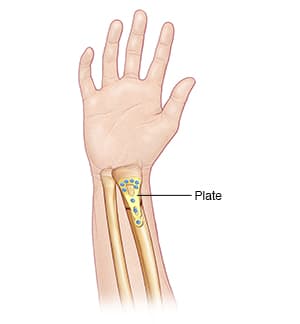
Open reduction with internal fixation is a surgical procedure that may be used. It is used if the fracture is badly misaligned or unstable, the fracture involves one of the joints in the hand, or you have an open fracture. An open fracture means the skin over a fracture is damaged, either because the bone has poked through the skin or there is a wound over the fracture.
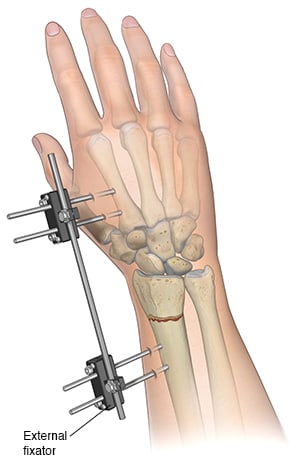
You may get medicine during the procedure to let you sleep and relax your muscles. Or you may have local or regional medicine to numb the area. Your doctor then makes one or more cuts (incisions) to realign the bone and fix soft tissues. Pins, screws, plates, or a combination of hardware may be used under the skin to hold the bone in place during healing. Another device that may be used is an external fixator. It's surgically placed on the outside of the skin to hold the bones in the right position. It is removed or replaced with internal hardware as the injury heals.
The road to healing
Fractures take about 6 weeks or more to heal. But it can take a year to fully recover. Keeping your hand raised above your heart whenever possible can help control swelling, throbbing, and pain. Your doctor may give you medicine to help ease pain. Don't remove a splint unless your doctor says you can. Contact your doctor if your pain gets worse or if you notice a lot of swelling or redness. Sometimes hardware, especially wires and external fixators, may need to be removed after the broken bone has healed.
Online Medical Reviewer: Rahul Banerjee MD
Online Medical Reviewer: Ronald Karlin MD
Online Medical Reviewer: Stacey Wojcik MBA BSN RN
Date Last Reviewed: 09/01/2025
© 2000-2026 The StayWell Company, LLC. All rights reserved. This information is not intended as a substitute for professional medical care. Always follow your healthcare professional's instructions.