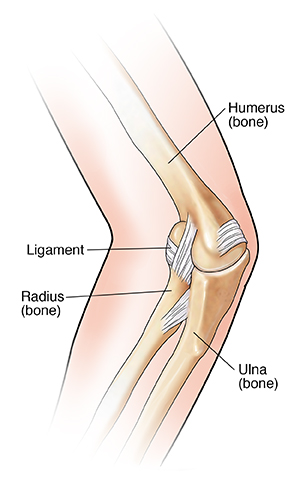
The elbow is a joint made up of three bones held in place by strong bands of tissue (ligaments). One ligament is looser in young children than in adults. As a result, soft tissue may become trapped between the bones in a child's elbow joint. The medical name for this injury is radial head subluxation. It often happens when a child is lifted or pulled by one arm, and the elbow partly dislocates.
Risk factors
Children under age 4 are most likely to have a radial head subluxation. As children grow older, their elbow ligaments become stronger. For that reason, this injury rarely happens after age 6.
When to go to the emergency room (ER)
A radial head subluxation causes sudden pain. In addition, your child won't be able to flex their elbow. The injured arm is likely to hang loosely at your child's side, and they won't move or use it. If your child's healthcare provider can't see them right away, go to the nearest emergency room (ER).
What to expect in the ER
A healthcare provider will examine the injured arm. An X-ray may be taken. The provider will then gently move the joint to release the trapped tissue. Your child can sit on your lap facing the provider while this is done. It's likely to hurt for just a minute. Your child will be fine once the parts of the joint are all back in place. Most often, no other care is needed.
Preventing a pulled elbow
These tips can help prevent radial head subluxation in a child:
-
Lift your child under the arms—not by the hands or wrists.
-
Don`t swing your child by the arms.
-
Don`t pull your child by the hand or arm, even when you`re in a hurry.
Online Medical Reviewer: L Renee Watson MSN RN
Online Medical Reviewer: Raymond Turley Jr PA-C
Online Medical Reviewer: Thomas N Joseph MD
Date Last Reviewed: 10/01/2024
© 2000-2026 The StayWell Company, LLC. All rights reserved. This information is not intended as a substitute for professional medical care. Always follow your healthcare professional's instructions.