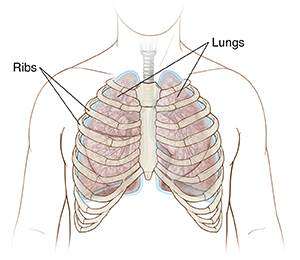
Your ribs are curved bones in your chest. They help protect your lungs and expand and contract when you breathe. Children's ribs bend easily and can often withstand a blow or fall. But adult ribs are more likely to break (fracture) under stress. Even coughing or a hard sneeze can fracture a rib.
When to go to the emergency room (ER)
Although they can be painful, most rib fractures aren't serious. But they often make it hard to cough or breathe deeply. Get to the ER or call 911 right away if you have:
-
Trouble breathing
-
Nausea, vomiting, or stomach pain with a sore or bruised rib
-
Pain that gets worse over time
-
An injury to the chest or stomach
What to expect in the ER
Here's what will happen in the ER:
-
A healthcare provider will ask about your injury and examine you carefully.
-
An X-ray of your chest will likely be taken to show any major damage to ribs and lungs. But ribs can have small breaks that don't show up on X-rays, even though they still hurt. In some cases, a CT scan may be done.
-
You may be given medicine to ease your discomfort.
-
In rare cases, rib fractures can cause a lung to collapse or lead to bleeding in the chest. In these cases, a tube will be inserted into the chest to reinflate the lung or drain the blood.
Follow-up
You are likely to heal in 6 to 8 weeks. Most rib fractures heal on their own with no lasting effects. Call your healthcare provider right away if you notice any of these symptoms:
-
Increased chest pain
-
Shortness of breath
-
Fever of 100.4°F (38°C) or above, or as advised by your provider
-
Chills
-
Coughing up blood
Online Medical Reviewer: L Renee Watson MSN RN
Online Medical Reviewer: Raymond Turley Jr PA-C
Online Medical Reviewer: Thomas N Joseph MD
Date Last Reviewed: 07/17/2013
© 2000-2026 The StayWell Company, LLC. All rights reserved. This information is not intended as a substitute for professional medical care. Always follow your healthcare professional's instructions.